Core Technologies Driving Spectropy AI


Continuous Learning & Adaptive AI
Spectropy AI continuously improves its predictive performance by learning from new drilling results and exploration data. As borehole observations and hyperspectral core scans become available, the platform updates its digital twin, refines mineral probability estimates, and reduces prediction uncertainty. This adaptive learning framework enables the AI model to evolve with every exploration campaign. Rather than remaining static, Spectropy AI becomes increasingly accurate over time, ensuring that future exploration decisions are driven by the latest geological evidence and continuously expanding knowledge.
Convolutional Neural Networks (CNNs)
Convolutional Neural Networks (CNNs) are a core deep learning technology used by Spectropy AI to identify complex spatial patterns within geophysical, hyperspectral, geological, and remote sensing datasets. By automatically learning features such as geological structures, fault systems, mineral alteration zones, and geophysical anomalies, CNNs eliminate the need for extensive manual interpretation. Their ability to process large volumes of spatial data enables faster, more accurate mineral prospectivity mapping and target generation. At Spectropy AI, CNNs serve as the foundation for intelligent pattern recognition, helping exploration teams uncover hidden mineralization trends and make data-driven exploration decisions with greater confidence.
Mineral Exploration


Bayesian Neural Networks (BNNs)
Bayesian Neural Networks (BNNs) extend traditional deep learning by quantifying uncertainty in every prediction. Instead of generating only a single mineral probability, BNNs estimate confidence levels for each exploration target using probabilistic inference and Monte Carlo sampling. This helps geologists distinguish between high-confidence discoveries and areas requiring additional investigation. Spectropy AI leverages BNNs to support risk-aware exploration decisions in data-sparse environments. By combining prediction accuracy with uncertainty estimation, the platform enables smarter drilling strategies, reduced exploration risk, and more reliable mineral targeting.
Physics-Informed Neural Networks (PINNs)
Physics-Informed Neural Networks (PINNs) combine deep learning with established geological and geophysical principles. Rather than relying solely on historical data, PINNs incorporate physical constraints such as gravity, magnetic behavior, and subsurface properties directly into the learning process. This ensures that AI predictions remain scientifically consistent and geologically realistic. By integrating domain knowledge with machine learning, Spectropy AI reduces unrealistic predictions and improves model robustness. PINNs help produce reliable subsurface interpretations even in complex geological settings, supporting more accurate exploration outcomes.
Multi-Modal Data Fusion
Multi-Modal Data Fusion enables Spectropy AI to integrate geophysical, geological, borehole, hyperspectral, geochemical, and remote sensing datasets into a unified AI framework. The system learns relationships between multiple data sources and dynamically assigns importance to each dataset based on its relevance. This intelligent fusion reduces the influence of noisy or incomplete information while enhancing prediction accuracy. By combining complementary geological evidence, Spectropy AI generates a more comprehensive understanding of the subsurface. The result is improved mineral prospectivity mapping and better-informed exploration decisions across diverse geological environments
3D Geological Digital Twin
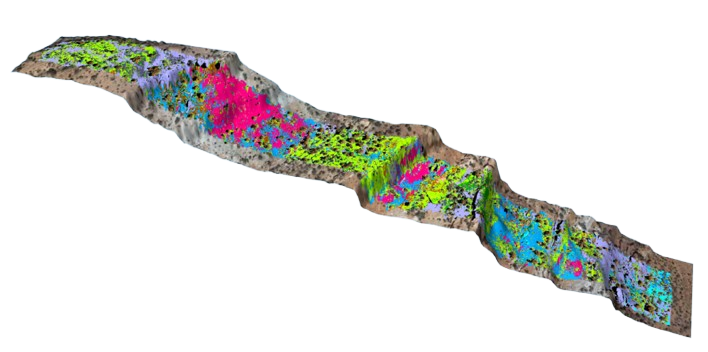
Spectropy AI creates a dynamic 3D Geological Digital Twin that serves as a virtual representation of the Earth's subsurface. Geological structures, lithology, geophysical anomalies, and borehole information are integrated into a voxel-based 3D model. Unlike static geological models, the digital twin continuously updates as new exploration data becomes available. This enables real-time visualisation of subsurface conditions and supports more accurate mineral prediction. By maintaining a living model of the exploration area, Spectropy AI improves interpretation, planning, and long-term exploration efficiency.


Hyperspectral Imaging

Scientific Basis:
Each mineral reflects specific wavelengths due to its molecular vibrations and electronic transitions, particularly in the SWIR region.
AI and machine learning models process this spectral data to correlate reflectance curves with mineralogical and geochemical datasets, enabling real-time grade estimation.
This fusion of spectral science and data analytics helps bridge the gap between visual surface data and subsurface grade models, bringing lab-grade accuracy to field-scale decision-making.
In essence:
Spectropy turns light into data — and data into actionable geological intelligence.
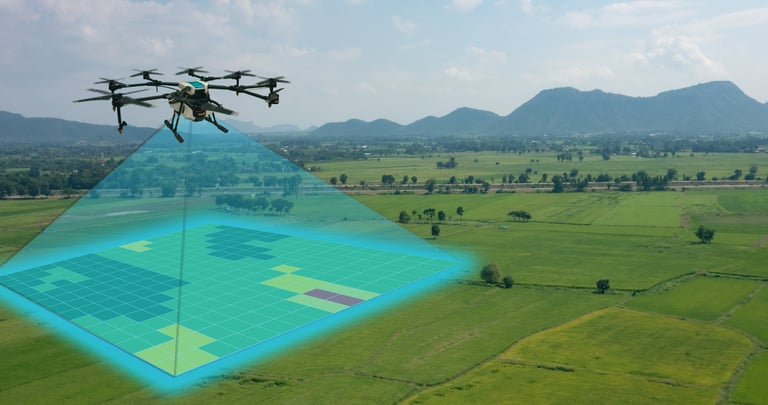
Hyperspectral imaging is a remote sensing technology that captures information across hundreds of narrow and contiguous spectral bands, extending far beyond what the human eye or standard cameras can detect. Each mineral and material has a unique spectral signature — a distinct way it reflects and absorbs light across different wavelengths. By analyzing these spectral fingerprints, Spectropy identifies and quantifies minerals, grades, and compositional variations with laboratory-level precision from aerial or ground-based platforms.
Spectral Range Used:
Spectropy operates across the Visible to Short-Wave Infrared (VNIR–SWIR) range: 400 nm to 2500 nm, covering the key spectral absorption features of most rock-forming and alteration minerals.
VNIR (400–1000 nm): Sensitive to iron oxides, vegetation, and surface reflectance.
SWIR (1000–2500 nm): Critical for identifying clay minerals, carbonates, sulfates, and hydroxyl-bearing minerals that define alteration zones and ore boundaries.
Mineral Exploration